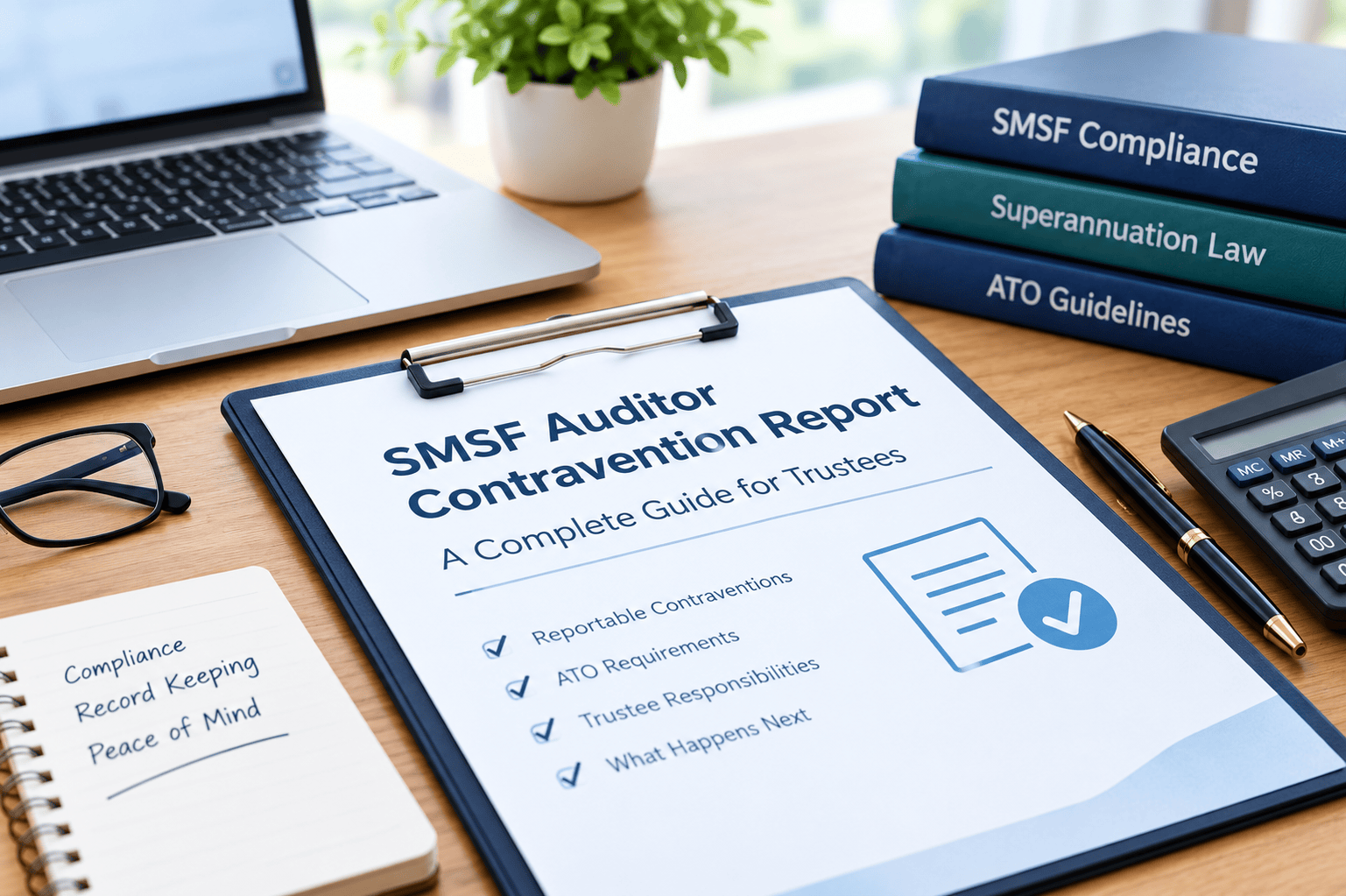
SMSF Auditor Contravention Report: A Complete Guide for Trustees
Running an SMSF means staying on top of superannuation rules, keeping accurate records, and making sure every transaction stacks up against the law. When an auditor comes across a reportable compliance issue, trustees often hear the term SMSF auditor contravention report for the first time — usually with a bit of concern.
Here's the reassurance upfront: an Auditor/actuary Contravention Report (ACR) is used to report certain SMSF contraventions to the Australian Taxation Office (ATO) once the relevant reporting requirements are met. Getting one doesn't automatically mean your fund will be penalised — but it is something that needs to be dealt with promptly.
What Is an SMSF Auditor Contravention Report?
An SMSF auditor contravention report is lodged by an approved SMSF auditor or actuary to notify the ATO about certain reportable contraventions they've picked up during an audit.
As part of the process, the auditor looks at both the fund's financial position and its compliance obligations, then works out whether whatever they've found meets the threshold for reporting.
What Does ACR Stand For in SMSF?
ACR stands for Auditor/actuary contravention report. You'll sometimes see it written as SMSF ACR, ACR SMSF, or ACR report SMSF — they all refer to the same reporting process.
When Does an SMSF Auditor Lodge an ACR?
Not every mistake or compliance slip automatically triggers an ACR. The auditor has to weigh up the nature of the contravention and check whether it meets the relevant reporting criteria.
Some of the areas that tend to draw attention include:
- Related-party transactions
- In-house asset breaches
- Unauthorised loans
- Investment strategy issues
- Incorrect asset ownership
- Separation of SMSF assets
- Contribution or pension problems
- Certain documentation issues
The auditor independently assesses the circumstances before deciding whether a report is actually required.
Common SMSF Audit Contravention Problems
More often than not, these issues stem from poor documentation, incorrect transactions, or trustees simply not realising a particular obligation applied to them.
Related-party dealings, weak investment strategies, ownership mix-ups, and patchy record keeping are the usual culprits. Keeping your documentation current throughout the year — and getting advice before entering into anything unusual — goes a long way toward reducing the risk of a contravention.
SMSF ACR vs SMSF Auditor Report
An SMSF auditor report and an ACR are two different documents, and it's worth knowing the distinction.
|
Report |
Purpose |
|
SMSF Audit Report |
Provides the auditor's opinion |
|
SMSF ACR |
Reports certain contraventions |
|
Qualified Audit Report |
Identifies matters affecting the audit opinion |
So an ACR shouldn't be confused with the auditor's overall audit report — they serve two separate purposes.
What Happens After an ACR?
This is usually the first thing on a trustee's mind once an ACR has been lodged.
The starting point is understanding exactly why the report was made, talking it through with your accountant or adviser, and taking whatever corrective action is appropriate.
It's also worth keeping evidence of any rectification you carry out. For certain reportable contraventions, the auditor is required to lodge the ACR with the ATO within 28 days of forming their conclusion.
Does an ACR Mean Your SMSF Will Be Penalised?
No — an ACR doesn't automatically lead to a penalty.
The ATO takes the specific circumstances of the contravention into account when deciding whether any further compliance action is warranted. What matters most for trustees is taking the issue seriously, understanding what went wrong, and addressing it as soon as reasonably possible.
What Should Trustees Do After Receiving an ACR?
If your fund has received an ACR, start by reviewing the auditor's findings. From there, a sensible approach looks like this:
- Understand the reported contravention.
- Gather the relevant documents.
- Speak with your accountant or adviser.
- Rectify the issue where possible.
- Keep evidence of the corrective action.
- Review your processes to prevent it happening again.
Acting promptly makes the whole thing much easier to manage.
Can an SMSF Contravention Be Fixed?
In many cases, yes — depending on the circumstances.
That said, correcting a breach doesn't automatically remove the auditor's obligation to report it. The auditor still has to independently assess the issue against the relevant requirements, regardless of whether it's since been fixed.
Trustees should document whatever steps they take and hold onto supporting evidence.
How Long Does an SMSF Auditor Have to Lodge an ACR?
For applicable reportable contraventions, the auditor generally has 28 days to lodge the ACR after reaching their conclusion.
That's exactly why trustees should respond quickly once an auditor flags a compliance issue, rather than waiting until the end of the financial year to deal with it.
Common SMSF Audit Problems Trustees Should Avoid
Some SMSF audit problems come down to simple admin mistakes that could easily have been avoided with better records. Keep an eye out for:
- Missing trustee minutes
- Incomplete transaction records
- Incorrect asset ownership
- Poorly documented related-party transactions
- Outdated investment strategies
- Unsupported expenses
- Unauthorised loans
- Insufficient property documentation
Keeping your records in order throughout the year makes the annual audit far less stressful.
How to Avoid SMSF Audit Contraventions
Trustees can cut down on compliance risk by keeping their records organised and reviewing significant transactions before they happen. Important documents to have on hand include:
- Bank and investment statements
- Trustee minutes and resolutions
- Investment strategy
- Property documents
- Contribution records
- Pension payment records
- Related-party transaction documents
- Evidence of asset ownership
Good documentation gives your auditor everything they need to complete an effective SMSF compliance audit.
SMSF Auditor Contravention Report Australia: Why Professional Auditing Matters
If you're searching for information on an Auditor Contravention Report Australia, it helps to understand the role the auditor actually plays.
An independent SMSF auditor reviews the fund's financial and compliance position and flags anything that may need attention. Catching issues early can help trustees deal with them before they turn into something more serious.
Working with a professional auditor also gives trustees greater confidence that their fund's compliance obligations are being properly reviewed.
Why Choose Wise SMSF Audits?
Wise SMSF Audits provides independent SMSF audit services for trustees, accountants, SMSF administrators and advisers across Australia.
Our online audit process is built to be secure and efficient, with fixed-fee pricing and a streamlined digital workflow.
If you need an independent SMSF auditor for your annual audit, get in touch with Wise SMSF Audits to discuss your requirements.
FAQs
1. What is an ACR report for an SMSF?
An ACR is used by an SMSF auditor or actuary to report certain contraventions to the ATO once the applicable reporting requirements are met.
2. What does ACR mean in SMSF?
ACR means Auditor/actuary contravention report.
3. Does every SMSF contravention require an ACR?
No. The auditor has to assess the issue against the applicable reporting requirements — not every compliance issue ends up as an ACR.
4. What happens after an ACR is lodged?
The trustee should understand the reported issue, get appropriate professional advice, rectify the breach where possible, and keep evidence of the corrective action.
5. Is an ACR the same as a qualified audit report?
No. An ACR reports certain contraventions, while a qualified audit report relates to matters affecting the auditor's opinion.
6. What is an SMSF auditor ACR?
An SMSF auditor ACR is the Auditor/actuary Contravention Report used to report applicable SMSF contraventions to the ATO.
7. Can an SMSF contravention be corrected?
In many cases, yes. The right corrective action depends on the nature of the contravention and the circumstances of the fund.
8. How long does an auditor have to lodge an ACR?
For applicable reportable contraventions, the auditor generally has 28 days to lodge the report after forming their conclusion.